
A small setup, with a deliberate choice.
When I come to your home in Cary, I’ll bring one Beyond Power VOLTRA I and a single handle for much of our cable work. For a press, row, or curl that suits your setup, that means completing a set with one arm, then switching to the other. We’ll train both sides, one at a time.
That choice keeps the equipment portable and leaves us room to move. But convenience only gets us so far. You’re hiring me to help you get stronger, and it’s reasonable to ask whether working with one handle puts you at a disadvantage.
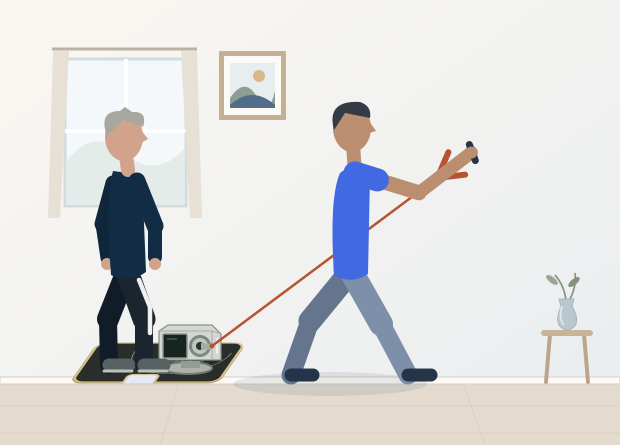
Working one arm or leg at a time is called unilateral training. Working both together is bilateral. A single handle describes the attachment; whether an exercise is unilateral depends on which limbs do the work.
The VOLTRA I supplies digitally controlled cable resistance. My job is to choose movements, positions, and resistance settings that make that equipment useful for your goals.
The featured paper
What happens when researchers compare the two?
A 2025 review by Kassiano and colleagues combined nine studies with 200 participants. Most examined lower-body exercises; only two contributed muscle-growth measurements. The studies compared unilateral and bilateral training, not this VOLTRA-based service.
Strength depended on the test.
Bilateral training produced larger improvements on bilateral strength tests. Unilateral training produced larger improvements on unilateral tests. People tended to improve more at the pattern they practiced.
Muscle growth was less certain.
The review did not detect a difference in muscle growth. With so few studies and wide uncertainty, that does not establish that the approaches are equivalent. The authors also judged the studies to have moderate risk of bias overall.
The strength findings support including one-arm work in our sessions. As a statistician, I’d leave the muscle-growth comparison open.
Here’s how I’ll use that in your sessions.
For your program, I’ll use one-arm movements where the exercise and available setup make sense. During the home assessment, we’ll consider the space, cable direction, and suitable mounting options. If a movement needs an anchor your home doesn’t offer, we’ll choose another movement.
I’ll also count the work separately for each side. Suppose we plan two sets of a cable press per arm. That means two left-arm sets and two right-arm sets: four individual sets to perform, but two sets of work for each arm. Keeping those quantities straight matters when planning a session and reviewing it later.
Counting the work · example
Four sets to perform. Two sets per arm.
Switching arms also takes time. I’ll allow for rest and position changes when choosing how many exercises to include in our 60-minute session. The plan has to work in your living room and on your calendar.
We won’t make every movement one-sided just because there’s one cable. I’ll consider the whole program, including suitable movements that involve both legs, and explain how each exercise fits.
The two sides get their own records.
With one handle, we can record what happened on the left and right separately. I’ll keep track of the exercise, resistance, repetitions, and how demanding the set felt. I’ll note the setup too: mount height, your position, and the movement we’re trying to repeat.
Those details give the numbers context. If you complete more repetitions after changing your stance or shortening the movement, I want to understand what changed before calling it progress. A single session where one arm does better also isn’t enough for me to label a problem.
This is where my statistics background belongs in the service. I’ll review your records between sessions, look for patterns across comparable workouts, and use them alongside what I observe and what you tell me. Then we can decide whether to adjust the resistance, the repetitions, or the exercise itself.
There are tradeoffs worth discussing.
A single handle gives us a compact starting point, with separate work for each side. It also means we have to budget time for both sides, and our exercise options depend on the available setup. If your priority is a particular barbell lift, we should discuss equipment and practice that suit that goal.
For Concierge Strength, I’m building a service around bringing manageable equipment to your home, coaching each session, and paying attention to your response. The single VOLTRA is part of that plan. The assessment is where we decide whether the plan fits you.
Sources & scope
- Kassiano W, Nunes JP, Costa B, Ribeiro AS, Loenneke JP, Cyrino ES. Comparison of Muscle Growth and Dynamic Strength Adaptations Induced by Unilateral and Bilateral Resistance Training: A Systematic Review and Meta-analysis. Sports Medicine. 2025;55:923–936.
- Beyond Power. VOLTRA I product information. Manufacturer information describes the equipment; it is separate from evidence about training outcomes.
The session plans described here are my proposed coaching approach. This article explains the rationale for that approach; it does not report results from Concierge Strength clients.